What is the EYLF?
Its full title is “Belonging, Being and Becoming: The Early Years Learning Framework for Australia”. It sets out the learning outcomes educators work towards with children from birth to five, and the principles and practices they use to get there.
The title sums up how it sees early childhood. Belonging is knowing where and with whom you belong — family, community, culture and place. Being is about the here and now, because childhood matters in its own right and not only as preparation for school. Becoming is the rapid growth and change of the early years.
What are the five EYLF learning outcomes?
The EYLF sets out five learning outcomes for every child:
- Children have a strong sense of identity
- Children are connected with and contribute to their world
- Children have a strong sense of wellbeing
- Children are confident and involved learners
- Children are effective communicators
Educators plan experiences around these outcomes and assess each child’s progress towards them. They overlap on purpose: one morning of block building can involve identity, wellbeing, learning and communication all at once.
What principles and practices guide educators?
Version 2.0 has eight principles, which describe what educators value, and a set of practices, which describe what they do. Three of the principles are new in V2.0.
The eight principles
- Secure, respectful and reciprocal relationships
- Partnerships
- Respect for diversity
- Aboriginal and Torres Strait Islander perspectives
- Equity, inclusion and high expectations
- Sustainability
- Critical reflection and ongoing professional learning
- Collaborative leadership and teamwork
The practices
- Holistic, integrated and interconnected approaches
- Responsiveness to children
- Play-based learning and intentionality
- Learning environments
- Cultural responsiveness
- Continuity of learning and transitions
- Assessment and evaluation for learning, development and wellbeing
What does the EYLF look like in my child’s day?
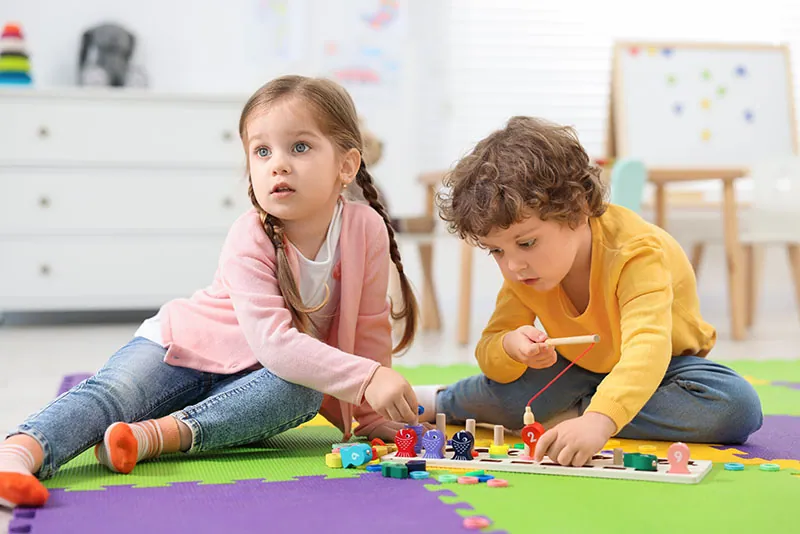
Mostly, it looks like play. Play-based learning is one of the framework’s practices, with educators setting up experiences on purpose and joining in to extend what children are learning.
- Building with blocks: early maths, problem solving and working together.
- Dress-ups and pretend play: language, imagination and understanding other people.
- Outdoor play: physical skills, confidence and wellbeing.
- Stories and group times: listening, taking turns and early literacy.
- Gardening or caring for the environment: sustainability, one of the framework’s principles.
Does the EYLF apply to before and after school care?
No. School-age children in outside school hours care follow a different approved framework: “My Time, Our Place: Framework for School Age Care in Australia” (V2.0).
How does Jolly Frog use the EYLF?
Our programs at Westmead and Northmead follow the Early Years Learning Framework, with play-based, intentional learning and a school-readiness program for children in the years before school.
Read more on our school readiness and EYLF program page, or book a tour to see it in action.